
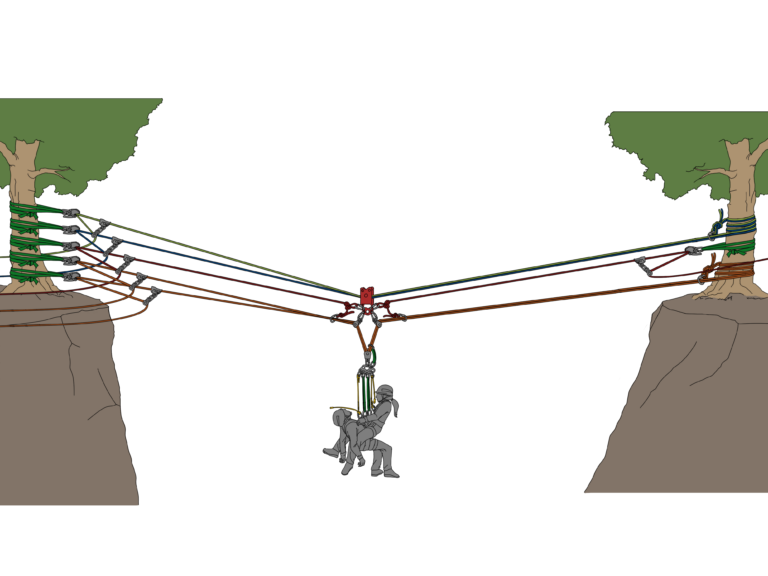
Highline systems are built to move a load across a horizontal span when direct vertical access is not possible or introduces unnecessary risk. The system must maintain clearance, control, and stability while transporting the load from one side to the other. This is not achieved through a single rope or device, but through a structured system where each component serves a defined role.
At the most basic level, a highline separates movement into two distinct functions: horizontal positioning and vertical control. Horizontal movement is managed through taglines, while vertical movement—when required—is handled through reeve systems. The trackline provides the structural path between anchors, carrying the load across the span.
This separation of function is what makes the system predictable. When each component operates independently, operators can adjust position, elevation, or tension without unintentionally affecting other parts of the system. When this separation is lost, the system becomes difficult to control and forces become unclear.
Core System Structure
A highline system is made up of several primary components that must work together without interfering with one another.
The trackline is the main structural element. It spans between two anchors and carries the load across the gap. Its tension and alignment determine both clearance and system behavior. If the trackline is poorly tensioned, the entire system becomes unstable.
The carriage moves along the trackline and connects the load to the system. It typically uses large pulleys to reduce friction and allow smooth movement. The carriage is also where primary and backup systems are integrated, making it a critical control point.
Taglines control horizontal movement. They are managed from both sides of the span and allow operators to position the load precisely. Taglines do not carry the main load but are essential for control and stability.
Reeve systems, when used, provide vertical control. They allow the load to be raised or lowered independently of the trackline. This is necessary in terrain where elevation changes cannot be avoided.
Each of these components must remain independent. When lines are shared, crossed, or combined, system behavior becomes unpredictable and risk increases.
Anchor Systems and Independence
Everything in a highline system ultimately transfers force into the anchors. If the anchors are not properly built, nothing else in the system matters.
Each system component must be anchored independently. The trackline, taglines, and reeve lines should not rely on the same anchor point or failure pathway. Shared anchors create shared failure. If one anchor fails, multiple systems fail at once.
Independent anchoring ensures that a failure in one part of the system does not compromise the entire operation. It also makes force distribution easier to understand. When each line has its own anchor, operators can see how forces are moving and make adjustments accordingly.
Anchor alignment is equally important. Clean alignment reduces side loading and keeps forces moving directly into the anchor system. Poor alignment introduces unnecessary stress and reduces overall system efficiency.
Movement and Control Across the Span
Movement in a highline system must be controlled at all times. The load should never move freely or unpredictably.
In a non-reeving system, movement is controlled entirely through taglines. One side pulls while the other releases, allowing the load to move across the span. This requires coordination. If operators are not synchronized, the load will swing, stop abruptly, or drift.
In a reeving system, vertical movement is added. This allows operators to raise or lower the load while moving it horizontally. The advantage is precision. The tradeoff is complexity. More systems must be managed, and communication becomes more critical.
Regardless of configuration, movement must be deliberate. Sudden inputs introduce dynamic forces that increase stress on the system and reduce control.
Tension and System Behavior
Tension is one of the most important—and most misunderstood—elements of a highline system.
As span length increases, tension increases. This relationship is not linear. Small reductions in sag can create large increases in force at the anchors. Over-tensioning is one of the most common failure points in highline systems.
Sag is not a mistake—it is a tool. Controlled sag reduces tension and distributes load more effectively. The goal is to balance sag and clearance, not eliminate sag entirely.
Tension must be applied gradually and monitored continuously. Mechanical advantage systems allow operators to apply force, while progress capture devices hold that force in place. Force-limiting devices help prevent excessive tension from entering the system.
Redundancy and System Safety
Highline systems must be built with failure in mind. Redundancy is not optional.
A secondary trackline or backup safety line ensures that the load remains supported if the primary system fails. These systems must remain independent. If both systems share the same anchor or pathway, redundancy is lost.
The carriage often integrates both primary and backup connections. This ensures that the load is always connected to more than one system.
Redundancy also stabilizes the system. Multiple lines working together reduce movement variability and improve control.
System Organization and Discipline
A highline system must be organized. Lines should be clearly separated, properly routed, and easy to identify.
Disorganized systems create friction, confusion, and increased risk. Lines that cross or interfere with each other introduce unnecessary wear and unpredictable behavior.
Clear organization improves both safety and efficiency. Operators can quickly identify problems, make adjustments, and maintain control during the operation.
Closing Perspective
A highline system is not defined by the equipment used, but by how the system is built and managed. Control, separation, and clarity are the defining characteristics of a functional system.
When each component has a clear role, when forces are understood, and when movement is controlled, the system performs as intended. When those principles are ignored, the system becomes unpredictable and risk increases.
Peace on your Days
Lance


